
Ever feel like reviewing financial documents is just another compliance box to check? It shouldn’t be.
Creating and evaluating the right documents does much more than satisfy regulations—it holds your nonprofit accountable and reinforces trust with supporters by showing them exactly where the funds go. Plus, reporting helps you anticipate cash flow issues and manage them proactively rather than reactively.
In this guide, we’ll walk you through the six financial documents your board should be reviewing.
The four core nonprofit financial statements
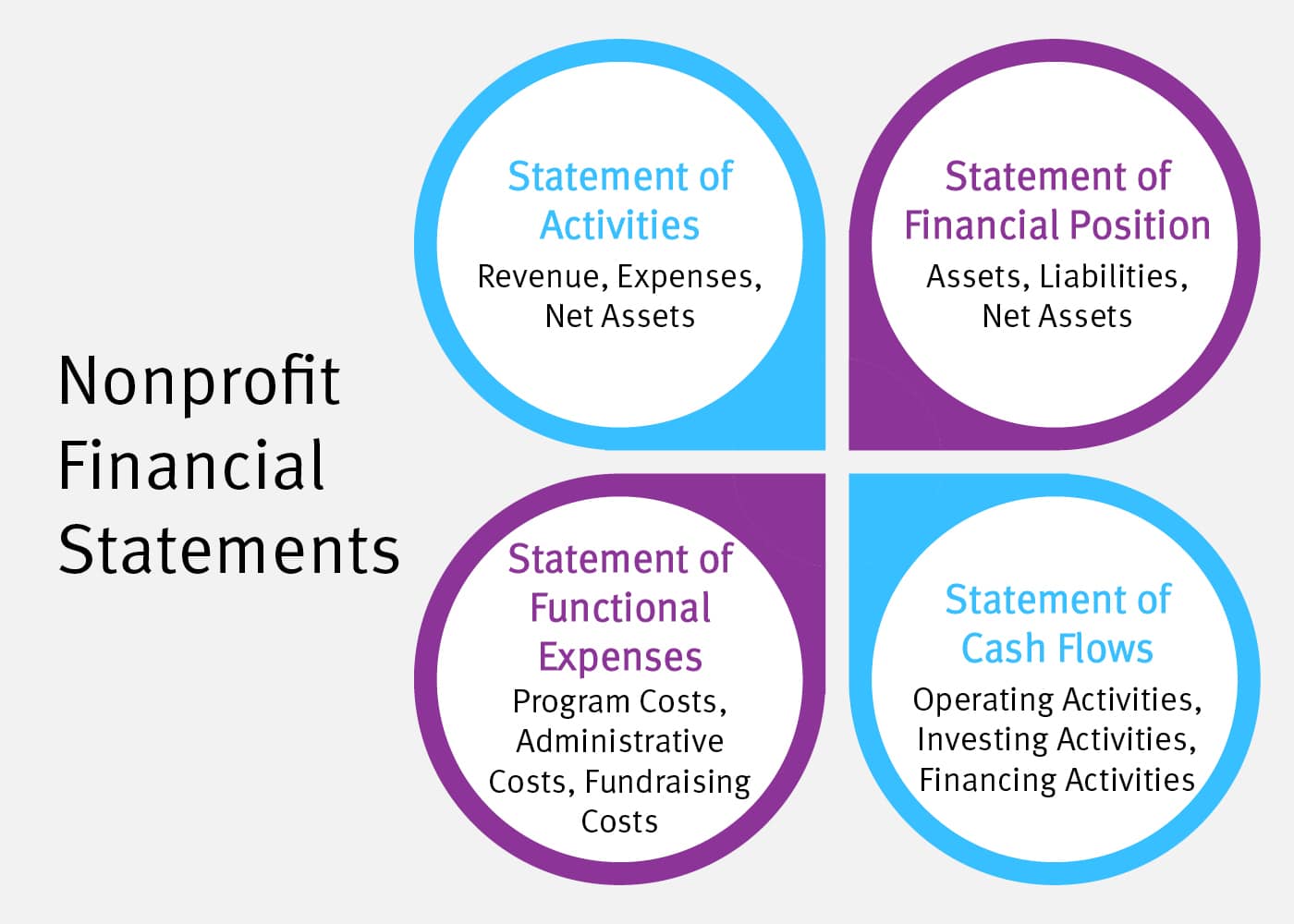
The four major nonprofit financial statements work together to give stakeholders, including your board, a complete overview of your nonprofit’s financial health. As Jitasa’s guide to nonprofit financial statements explains, these statements follow formats tailored to the reporting needs of tax-exempt organizations. Reviewing them regularly provides the visibility needed to catch problems early, ensure compliance, and track restricted funds.
Statement of financial position
This accounting report presents a snapshot of your nonprofit’s financial health by outlining assets, liabilities, and net assets. It’s the nonprofit equivalent of a balance sheet, and it answers a few simple but essential questions: what does your nonprofit own, what does it owe, and what is it worth?
This statement provides leadership with a clear picture of your financial standing at a specific point in time. Reviewing these figures regularly helps leaders assess whether your organization has the reserves and resources to take on new programs or absorb unexpected costs.
Effective financial management is what makes association growth possible. It gives you the stability to strengthen your internal systems, people, and resources—a process that, as UpMetrics’ nonprofit capacity building guide explains, is essential for scaling your impact over time.
Statement of activities
This report is the nonprofit equivalent of a for-profit income statement. It shows revenue, expenses, and net assets over a set period, organized by source and function, so leadership can see where funds came from and how they were used.
In this statement, revenue is broken down by source:
- individual donations
- corporate giving,
- earned income
- investment returns
- grants
Meanwhile, expenses are categorized by function (more on this later!). Understanding how the components of this nonprofit financial statement work together helps boards and financial professionals make more effective budgeting decisions.
Statement of cash flows
The statement of cash flows tracks the movement of liquid funds at your nonprofit—what came in, what went out, and through which channels—across operating, investing, and financing activities. These three categories give leadership a clear view of where money is being generated and where it’s being spent.
Regular review helps boards confirm they have enough accessible cash to cover day-to-day operations while continuing to fund longer-term programs. A nonprofit can look healthy on paper and still run into problems keeping its lights on and staff paid if liquidity isn’t monitored carefully.
Statement of functional expenses
Supporters and stakeholders want to know how your nonprofit’s funding furthers its mission. The statement of functional expenses makes this data visible by separating all of your spending into three categories: program, administrative, and fundraising costs.
This clean division between expense types allows stakeholders to evaluate your resource efficiency at a glance and gives leadership a useful lens for internal budget reviews. Administrative and fundraising expenses are together known as overhead, and while some overhead is necessary for your organization to operate, the majority of your funding should support your mission directly. Maintaining accurate expense records builds trust with donors and funders.
Conducting regular reviews of all four statements gives your board insight into financial strengths to capitalize on and potential issues to watch out for. Pairing these reports with visual dashboards can also help board members who aren’t financial professionals engage more confidently with financial data.
Foundational planning and compliance documents
In addition to financial statements, there are a few other documents your board should be aware of to help keep your association accountable, compliant, and prepared for the future.
Operating budgets
Your nonprofit’s annual operating budget is essentially its master financial plan. At the start of each fiscal year, you’ll lay out every expected revenue source and planned expenditure to provide clear parameters for financial activities and create a guide to measure performance against throughout the year.
Boards typically need to sign off on budgets before they go into effect, so you should make them as easy to manage as possible. Every anticipated income stream and cost should be documented, from grants and program fees to salaries and facility costs. Knowing how campaign fundraising fits alongside annual fund goals can help your board understand how revenue projections are structured.
Your operating budget should also use the same revenue and expense categories as your statement of activities. When the formats align, comparing projections to actual numbers is more straightforward, and variances are easier to explain.
Nonprofit treasurer reports
A nonprofit treasurer’s report is a summary of your financial data compiled and presented by the board’s financial leader. Unlike tax returns, which boards generally just review for accuracy, the treasurer’s report is an active decision-making document. Whether presented monthly or annually, it keeps you fully updated on the nonprofit’s financial health over a given period.
Leverage these documents with the goals of:
- Conducting budget reviews. Treasurer reports allow you to track progress by comparing budgeted versus actual revenue and expenses. This helps the directors make informed, short-term spending decisions and formulate long-term strategic plans.
- Facilitating donor conversations. Beyond internal use, a well-prepared report serves as a resource for outside stakeholders. It provides clear financial highlights that can be used to build trust and guide conversations with grantmakers and major donor prospects.
- Tracking key cash flows. A standard report clearly breaks down the beginning cash balance, categorized revenue, functional expenses, and the ending cash balance. This ensures the entire board is on the same page regarding exactly what funds are currently available to spend.
- Providing contextual analysis. Reports often include a notes section where the treasurer can add brief analyses, recommendations for improvement, and financial projections for the upcoming period, providing the context you need to govern effectively.
- Spotting variances early. Reviewing actual financials against the budget monthly helps you catch shortfalls before they compound. A mid-year variance isn’t necessarily a crisis—but one that goes unnoticed for six months often becomes one.
The 990 is also worth thinking about as a narrative opportunity. The program accomplishments section gives you space to describe what they actually did with donor funds—in plain language, for a public audience. If you treat this section as an afterthought, you might miss a chance to demonstrate impact.
Leveraging nonprofit financial documents for long-term sustainability
The nonprofits that get the most from their financial records are those that use them consistently—in board meetings, strategic discussions, and conversations with funders. Leverage these documents with the goals of:
- Driving sustainable growth. Identifying early signs of stalled fundraising often comes down to report and budget analysis. When leadership spots a funding gap early, they have time to adjust by cultivating new donor relationships, reallocating unrestricted funds, cutting overhead as it’s reasonable to do so, or scaling back lower-priority initiatives.
- Ensuring clear presentations. Not every board member has a finance background, and that’s fine. Presenting financial reports in plain language (with visuals where helpful) keeps all members engaged and able to ask the right questions.
- Planning with confidence. Good documentation makes forecasting more reliable. An understanding of major gift strategy and donor behavior, combined with accurate financial records, for instance, can help you anticipate seasonal giving dips, manage the timeline of multi-year campaigns, and plan effectively for the future.
One practical way to build your board’s financial literacy over time is to dedicate a short segment of each board meeting to explaining a single financial concept. Rotate through the six documents for a few months to help members develop a working understanding of your nonprofit’s finances without feeling overwhelmed.
Knowing which documents matter is only the first step—utilizing them is what helps your organization. Before your next board meeting, pull up your current financial packet and compare it against this list. If any of these documents are missing or challenging to understand, check with your team about sharing or adding explanatory notes to these documents.
 About the Author
Since joining Jitasa in 2010, Jon Osterburg has helped hundreds of nonprofits around the world effectively manage their finances through tailored, outsourced bookkeeping and accounting services. He currently serves as Jitasa’s Chief Operating Officer, is a member of two nonprofit boards, and has earned a certificate for Executive Education from the Yale School of Management.